
Since 1912
Our history
The North Toronto Lawn Bowling and Croquet Club has called Lytton Park home for over a century. Here's how it came to be.
The following was set down in Club documents from the 1970s to the early 2000s, and is shared here for your interest.
Town of North Toronto
In 1912, North Toronto was a small town on the outskirts of the City of Toronto, with a population of about 5,000 people living mainly along both sides of Yonge Street, between Davisville Avenue on the south and what is now Yonge Boulevard on the north. Behind this corridor of houses and other buildings there was largely just agricultural land. The Town Hall stood on the north-west corner of Yonge Street and Montgomery Avenue, which later became the site of the No. 12 Police Station and is now the Anne Johnston community health centre. There were very few automobiles at the time, and travel was mostly by an electric streetcar line connecting with the City of Toronto's system at Bloor Street to the south, which terminated at the top of the ravine known as Hogg's Hollow — now the site of a Loblaws supermarket. Travel north of the town was by another electric rail system that ran to Willowdale, Thornhill, Richmond Hill and beyond.
A few years after 1912, the town was absorbed by the City of Toronto, whose population was around 350,000. The growth of the city and steady improvements in transportation led to the development of the farmlands and open spaces on either side of Yonge Street. One of the areas marked for housing was Alexandra Gardens — now Lytton and Alexandra Boulevards — the region now known as Lytton Park.
Edward B. Stockdale
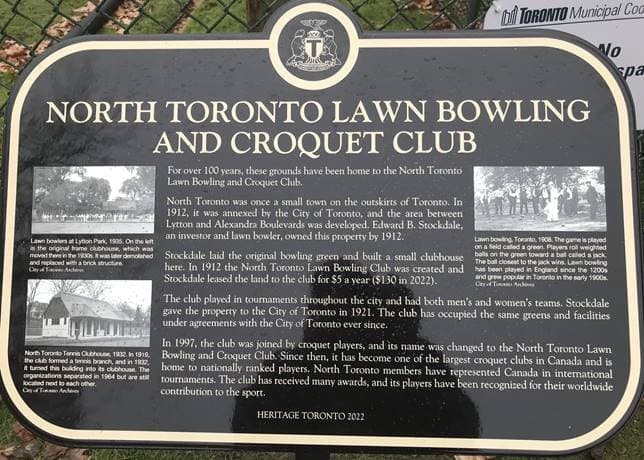
The Trusts and Guarantee Company was interested in Alexandra Gardens, and associated with that firm was a Mr. Edward B. Stockdale. Stockdale was not only a keen lawn bowler, but a public-spirited one as well. He laid down the original green and built a small clubhouse in the shallow ravine on his Alexandra Boulevard property, behind his house, which still exists. The original green and clubhouse stood on the site of the present north green. Stockdale's venture came to the attention of some members of the congregation of the Presbyterian Church at the north-west corner of Yonge Street and St. Clement's Avenue — later a public library and now a community centre. One of these people was a Mr. Thomas Kilgore, the first resident of Alexandra Gardens (December 1910). They approached Mr. Stockdale to arrange lawn bowling privileges for such members of their congregation as might be interested.
Lawn Bowling Club established
As a result of negotiations carried out over several months, Stockdale and others — three of whom, James Logie, James Brownlowe and Frank Arnold, each later served as President of the Club — obtained Letters of Patent in 1912 under the Ontario Companies Act for a corporation (No. 00001054) in the name of the North Toronto Lawn Bowling Club. Its purpose was the promotion of lawn bowling, curling, skating, tennis and other winter and summer sports. The first meeting of the directors was held on July 18, 1912. Stockdale's facility was leased from him for an annual fee of $5.00, and membership was limited to 75 — all men.
The initial membership was 33 men, but the Club did not remain a male preserve for long. Women members appeared in 1915 and were permitted two afternoons of bowling a week for an annual fee of $1.00. The exact terms of the lease have been obscured by the passage of time, but from the corporation's old minute books it seems that during the first ten years they were generous and elastic, with small annual rents ranging from $3.00 in 1914 to $75.00 five years later.
Although women were admitted in 1915, it was not until 1925 that the Ladies' Section received notice in the annual Yearbook — 49 women lawn bowlers were listed that year. In 1987, the Men's and Ladies' Sections were amalgamated.
Lawrence Park and other lawn bowling clubs
Interestingly, the Lawrence Park Lawn Bowling Club — located in Muir Park, just east of Yonge Street and two and a half blocks south of Lawrence Avenue — was also formed in 1912, and inter-club matches between North Toronto and Lawrence Park have taken place at least once a year ever since. The West Toronto Lawn Bowling Club and Kew Beach Lawn Bowling Club were also formed in 1912.
Tennis
In 1919 a subsidiary tennis club was formed and remained associated, albeit loosely, with its parent the North Toronto Lawn Bowling Club until 1964, when the two organizations amicably agreed to proceed on their separate ways. Today, the North Toronto Tennis Club is located just north of the lawn bowling greens.
Stockdale deeds the property to the City
In 1921, Edward Stockdale deeded the Club properties to the City of Toronto, and since then the Club has occupied its greens and clubhouse under various arrangements with the City. A major disruption occurred in 1928, when the greens were torn up to build the North Toronto trunk sewer, which enclosed a creek passing through the small ravine; its waters were routed south of Lytton Park, through what is now Eglinton Park, and eventually to Lake Ontario. Other bowling clubs came to the rescue: in 1928 the Club's bowlers were accommodated at the Granite Club, and in 1929 at the Oaklands Lawn Bowling Club.
New clubhouse
In 1930 the Club moved back to its original location, with two completely new greens laid over the trunk sewer. At the same time, the original frame clubhouse was moved from the north side of the north green to a position west of it, where within two years it was replaced by the present brick clubhouse. Aside from a new frame equipment shed and the erection of sun/rain canopies over the benches, little changed until 1971, when the frame shed was demolished and a new concrete-and-brick equipment building was constructed between the north and south greens. A permanent canopy with a latticework fence, joining the north clubhouse and the equipment building, was added in 1996.
Croquet
In 1997, the Club was approached by a group of avid croquet players who wished to bring their membership and their sport to its greens. At the fiscal year-end Annual General Meeting on October 31, 1997, 100% of the lawn bowlers in attendance voted in favour. The 1998 season was the first of many for both bowlers and croquet players at the Club.
The Club's name was changed officially to the North Toronto Lawn Bowling and Croquet Club, and a new Constitution and By-laws governing how the two sports would operate was approved in 2004.
Although its membership is ever-changing, the North Toronto Lawn Bowling and Croquet Club's character remains at a high level. The Club looks back with gratitude to its founding members and the many outstanding Presidents, benefactors and players whose names are preserved on Club trophies — and to the many men and women who have given years of unselfish service to the Club, a tradition that continues today.